


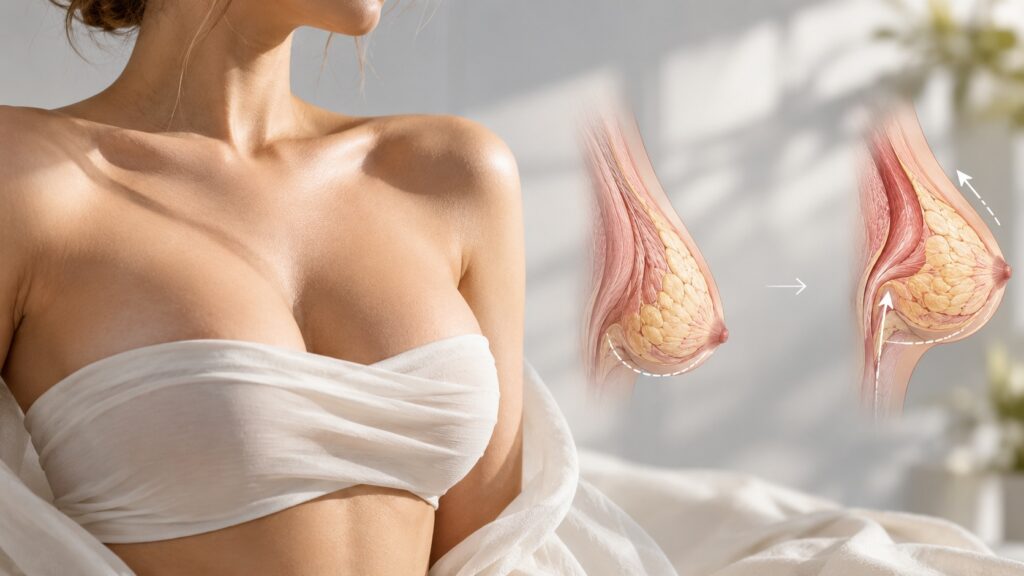
Breast aesthetic surgery does not automatically mean getting implants. For someone who wants to address sagging, reduced upper-pole fullness or changes after pregnancy and weight loss, surgery can sometimes work with the breast tissue that is already there.
What matters first is the change you are hoping to achieve. Lifting a breast, redistributing its existing volume and making the breast substantially larger are three different goals. An implant-free approach may address the first two in suitable patients, but it has limits when extra volume is the priority. Knowing those limits makes it much easier to understand what these procedures can, and cannot, realistically do.
What Does Implant-Free Breast Aesthetics Mean?
Implant-free breast aesthetics covers procedures that change breast position, contour or the distribution of existing volume without placing a silicone or saline breast implant. Depending on the patient’s anatomy and the technique being used, the surgeon may lift existing tissue, reshape or reposition it, or use the patient’s own fat to influence breast contour and volume.
Mastopexy, more commonly known as a breast lift, is a familiar example. It primarily addresses breast ptosis, or sagging, by reshaping the breast and, where appropriate, repositioning the nipple-areola complex. Autoaugmentation techniques can take this further. Instead of treating all lower breast tissue simply as tissue to remove, selected tissue may be retained and repositioned to support projection or upper-pole fullness.
There is an important distinction here: “implant-free” does not mean scar-free, surgery-free or appropriate for every patient. It means that a conventional breast implant is not being used to create the intended result.
Why Do Some Patients Look for Alternatives to Breast Implants?
There isn’t one universal reason. Some patients are comfortable with their existing breast volume but unhappy with where that volume sits. Others would simply rather use their own tissue where possible. For some, avoiding a permanent implant is itself an important consideration.
Preference for Using Natural Breast Tissue
When there is enough natural breast tissue, it may sometimes be possible to redistribute that tissue rather than supplement it with an implant. This becomes particularly relevant when the problem is less about the total amount of tissue and more about its position.
For example, a breast may have lost fullness in its upper portion while retaining more tissue lower down. In a suitable case, reshaping surgery can make use of that existing volume. Nothing new is being added; the surgeon is working with tissue that is already present and repositioning it.
Concerns About Having a Foreign Implant
Breast implants come with considerations that are specific to implanted devices. These include capsular contracture, rupture and the possibility that implant-related surgery may be needed later. If no implant is placed, those particular implant-related issues do not apply.
That should not be confused with having no surgical risk at all. Breast surgery can still involve bleeding, infection, delayed wound healing, asymmetry, changes in sensation and scarring. These are matters to discuss properly with a qualified surgeon before making a decision.
Expectations About Shape, Lift and Volume
“Do I need implants?” is not always the most useful first question. A better place to start is often: “What exactly do I want to change?”
Someone seeking a substantial increase in breast size may find that tissue rearrangement alone cannot create the volume they have in mind. Someone whose main concerns are sagging, breast shape or the distribution of existing fullness may be looking at a very different set of options.
This is why two patients with apparently similar concerns can end up discussing different procedures. The goal matters, but so does the anatomy available to achieve it.
What Is Autoprosthesis?
In breast aesthetic surgery, autoprosthesis generally describes an approach in which a patient’s own breast tissue is shaped and repositioned so that it functions as an internal volume-supporting structure. Surgical literature describes different forms of autoaugmentation and autoprosthesis mastopexy, including techniques that use tissue from the lower part of the breast to influence projection and upper-pole contour.
One specific development within this area is the Autoprosthesis approach presented by PureOwn. Its Dual-Plane Autoprosthesis technique uses an inferior dermoglandular pedicle created from the patient’s existing breast tissue. This tissue is repositioned into the subpectoral plane, where the pectoral muscle contributes to its support. The intention is to combine breast lifting with redistribution of natural tissue rather than adding an artificial implant.
How Does Autoprosthesis Use Existing Breast Tissue?
The surgical terminology can sound complicated, but the underlying idea is fairly straightforward. Tissue that has descended toward the lower part of the breast can, in selected patients, be preserved and formed into an internal flap. That tissue is then repositioned higher as part of the new breast structure.
Autoprosthesis is not one single, universally identical operation. Techniques differ in their flap design, fixation and the anatomical plane in which tissue is positioned. Tissue quality, breast dimensions, the degree of ptosis, previous breast surgery and the surgeon’s chosen technique all affect the plan.
How Is It Different From a Traditional Breast Implant?
The clearest difference is where the volume comes from. A breast implant introduces manufactured volume into the breast. An autoprosthesis technique uses tissue that the patient already has.
That difference also creates a limitation. Existing tissue can be reshaped and moved, but its quantity is finite. An implant can add volume in predetermined sizes and profiles. Autoprosthesis therefore should not be viewed simply as an implant made from natural tissue; the two approaches work differently and do not necessarily aim to solve the same problem.
Autoprosthesis vs Breast Implants: What Are the Main Differences?
Comparing these approaches as simply “natural versus artificial” misses much of the practical difference between them. The more useful comparison is what each approach can achieve for a particular breast shape, amount of existing tissue and desired outcome.
| Consideration | Autoprosthesis / Autoaugmentation | Breast Implants |
|---|---|---|
| Source of volume | Existing breast tissue | Implant adds new volume |
| Foreign implant | No conventional breast implant | Yes |
| Potential size increase | Limited by available tissue and technique | Greater control over added implant volume |
| Upper-pole contour | Created through tissue redistribution in suitable patients | Influenced by implant size, profile and placement |
| Implant-specific complications | Not applicable when no implant is used | Must be considered |
| General surgical risks | Still present | Still present |
| Patient selection | Existing tissue is particularly important | Depends on anatomy, tissue coverage and desired result |
Implant Material vs Existing Tissue
An implant is a separate medical device. In an autoprosthesis procedure, the tissue being repositioned belongs to the patient and remains connected to its blood supply through a surgical pedicle. That is a fundamental technical difference, not simply a difference in terminology.
For a patient who strongly prefers not to have implants, using existing tissue may sound appealing. Preference by itself, though, cannot establish whether the procedure is suitable. There must also be enough appropriate tissue to create the intended shape.
Volume and Shape Expectations
This is often where a very clear conversation with the surgeon is needed. Repositioning existing tissue may improve projection or fullness, but it cannot create unlimited additional volume.
If your reference for the desired result shows a substantially larger breast, ask whether that appearance can genuinely be achieved using your existing tissue alone. The answer may be yes for some goals and no for others. It is better to establish that distinction before surgery than to assume every form of breast augmentation can produce the same type of change.
Scarring, Recovery and Individual Anatomy
No implants does not mean no incisions. Autoprosthesis procedures are generally associated with breast reshaping or mastopexy, and the required scar pattern depends on how much lifting is needed and on the surgical plan.
Recovery is similarly individual. The extent of surgery, how much tissue is handled, personal healing characteristics and any additional procedures performed at the same time can all influence the postoperative period. A single recovery timeline cannot accurately describe every patient’s experience.
Where PureOwn Fits Into the Implant-Free Approach
pureown focuses on implant-free breast aesthetics and the Zereyak Autoprosthesis technique developed by Op. Dr. Umut Zereyak. The central idea is not to treat breast reshaping and implant placement as inseparable. Where the anatomy is suitable, the patient’s existing breast tissue is preserved and repositioned instead.
The Dual-Plane Autoprosthesis concept is based on positioning an inferior dermoglandular tissue segment in the subpectoral plane. Existing tissue can then contribute to upper-pole volume while the pectoral muscle provides support. This differs from autoaugmentation methods that primarily fold or fix glandular tissue within the breast itself.
Still, the technique is not presented as something that fits every breast or every aesthetic goal. Patient assessment, sufficient breast tissue and the degree of ptosis remain relevant to suitability. Anatomy sets real boundaries, regardless of how appealing a particular technique may sound in theory.
Who May Consider Implant-Free Breast Aesthetics?
No online checklist can determine whether someone is a suitable candidate. In general, though, patients who have breast ptosis and enough natural tissue to redistribute are among those discussed in medical literature concerning autoaugmentation mastopexy.
An implant-free approach may be worth discussing if you:
- want to improve breast position or shape without a conventional implant;
- have existing breast tissue that may be suitable for redistribution;
- are mainly concerned about sagging or reduced upper-pole fullness;
- prefer an autologous, or own-tissue, approach;
- understand that the amount of existing tissue limits how much fullness can be created;
- have realistic expectations about scars, recovery and changes over time.
Pregnancy, breastfeeding, substantial weight changes, aging and previous breast surgery can all affect the treatment plan. Skin quality matters as well. So even when two people ask for a similar-looking result, their surgical options may not be the same.
What About Fat Transfer?
Fat grafting belongs in the implant-free discussion too, but it is not the same thing as an autoprosthesis. With fat transfer, fat is removed from another area of the body through liposuction, processed and then injected into the breast. Autoprosthesis techniques instead reorganize tissue already located within the breast.
In selected cases, fat grafting may be used to add or refine volume. It has also been described alongside mastopexy and autoaugmentation. Not all transferred fat survives, however, and the amount that can be transferred depends on the individual case.
So although both can fall under the broader idea of breast aesthetics without conventional implants, they achieve this in different ways. One transfers fat from elsewhere in the body; the other works by redistributing existing breast tissue.
What Should You Ask During a Breast Aesthetics Consultation?
A consultation becomes more useful once the conversation moves beyond a simple “implants or no implants?” question. Be specific about what bothers you and what you would like to change: breast position, size, upper fullness, cleavage, scars, recovery or how natural you want the result to look and feel.
Questions worth asking include:
- What can realistically be achieved with my existing breast tissue?
- Is my main concern breast ptosis, volume loss, or a combination of both?
- How much upper-pole fullness can be created without an implant?
- Which surgical technique would you use in my case, and why?
- Where would the scars be located?
- What are the general surgical risks and the risks specific to this technique?
- How could pregnancy or future weight changes affect the result?
- What happens if my existing tissue is not enough for the volume I want?
- What should I realistically expect during recovery?
- Can I see results from patients whose anatomy was similar to mine?
These questions bring the discussion back to the part that matters most: whether a technique actually suits the patient. Procedure names are useful for research, but they do not replace individual assessment.
Making an Informed Decision About Implant-Free Options
Patients researching breast reshaping now have more to consider than the old assumption that meaningful aesthetic change necessarily requires an implant. Mastopexy, autoaugmentation, fat grafting and tissue-repositioning techniques address different combinations of sagging, shape and volume.
If your research is specifically focused on tissue-based upper-pole support, Implant-Free Breast Aesthetics offers further information about the Dual-Plane Autoprosthesis concept, patient selection and the way existing breast tissue is used within that approach.
The aim of researching these options should not be to choose an operation from an article. It should be to arrive at a consultation with a clearer idea of what you want and what you need to ask. Available breast tissue, anatomy, desired size, tolerance for scars and expectations about shape all influence the eventual decision. Sometimes the procedure that makes the most sense is not the one a patient first had in mind.
Frequently Asked Questions
1. Can breasts be lifted without implants?
Yes. Mastopexy can lift and reshape sagging breasts without inserting an implant. Whether it can also provide the upper-pole fullness you want depends on your anatomy, the amount of available tissue and the surgical technique.
2. What is an autoprosthesis in breast surgery?
An autoprosthesis generally uses a patient’s own breast tissue as an internal structure for shaping or supporting volume. There are different surgical versions of the concept, so the exact technique is not always the same.
3. Is autoprosthesis the same as a breast implant?
No. A breast implant is a manufactured medical device that adds volume. An autoprosthesis uses the patient’s existing tissue and does not add a conventional breast implant.
4. Can autoprosthesis increase breast size?
It may improve projection and redistribute fullness in suitable patients. The amount of volume available is limited by the patient’s own tissue, though, so it should not automatically be expected to produce the same size increase as an implant.
5. Can an implant-free breast lift restore upper-pole fullness?
It can in some patients. Autoaugmentation and tissue-repositioning techniques may improve upper-pole contour, but the degree of fullness that can be created varies with anatomy and available tissue.
6. Is fat transfer the same as breast autoaugmentation?
No, not necessarily. Fat transfer takes fat from another part of the body and injects it into the breast. Autoaugmentation generally reshapes or repositions existing breast tissue. In selected cases, the techniques may also be combined.
7. Does implant-free breast surgery leave scars?
Yes. Surgical lifting and reshaping of the breast require incisions. The position and extent of the scars depend on the technique used and how much correction is required.
8. Who may not be suitable for an autoprosthesis technique?
Someone without enough usable breast tissue, or someone seeking a substantial increase in breast volume, may not be a suitable candidate for tissue-only autoaugmentation. Health, anatomy and other individual factors also have to be assessed.
9. Does avoiding implants remove all surgical risks?
No. Avoiding an implant removes risks that specifically depend on having an implanted device, but it does not eliminate the risks of breast surgery itself. Bleeding, infection, wound-healing problems, asymmetry, scarring and sensory changes can still occur.
10. What happens to implant-free breast results over time?
Natural breast tissue continues to age. Skin elasticity, gravity, pregnancy, hormonal changes and fluctuations in body weight can all affect breast shape after surgery.
11. Can implant-free breast aesthetics be considered after pregnancy or weight loss?
Potentially. Pregnancy and significant weight loss can change breast position and skin support while leaving tissue that may be suitable for reshaping. An individual examination is needed to determine what can realistically be done with that tissue.
12. How do I choose between implants and an implant-free technique?
Start with the result you want rather than choosing a procedure name first. Discuss breast size, shape, upper-pole fullness, existing tissue, scars, risks and long-term expectations with an appropriately qualified plastic surgeon. Those details help determine which approaches are realistically compatible with your anatomy.
What is your reaction to this?


